Review
Easy Blog Networks Review 2026
Managed PBN Hosting for Operators Who Run Many Sites
Easy Blog Networks sells one thing: the removal of manual work from a multi-site WordPress estate. This review documents what the platform publicly commits to, what that means operationally, and where the trade-offs sit. BestPBNhost has not published a hands-on performance benchmark of EBN — every capability below is sourced to the vendor's own public pages and marked with the date we last verified it.
Independent disclosure: This page contains affiliate links. We may earn a commission at no additional cost to you.

Editorial verdict
Easy Blog Networks is our primary managed recommendation for operators running ten or more independent WordPress sites who want provisioning, updates and backups handled centrally while the sites themselves stay spread across large, ordinary cloud providers. The value is operational, not magical: it converts a pile of registrar, DNS, hosting and CMS chores into a single dashboard action, and it removes the slow failure mode — out-of-date sites — that kills most self-managed networks. It is the wrong tool if you need root access, non-WordPress stacks, or a single cheap box you fully control.
Strong for
- Agencies consolidating fragmented hosting accounts into one interface
- Operators adding sites in batches rather than one at a time
- Teams that want infrastructure spread across big-brand providers by default
- Anyone migrating an existing estate — transfers are handled by the vendor
Weak for
- Static sites, headless setups, or any non-WordPress stack
- Custom server configuration, root access, arbitrary services
- Single-site projects where managed tooling has nothing to amortise
- Buyers optimising purely on lowest monthly cost per site
What we did not test
- Speed, TTFB and uptime under load
- Support response times
- Indexation or deindexation outcomes
- Any figure we did not produce ourselves is attributed to its source
Affiliate link — no additional cost to you. View current plans and the 7-day trial on Easy Blog Networks.
What Easy Blog Networks actually is
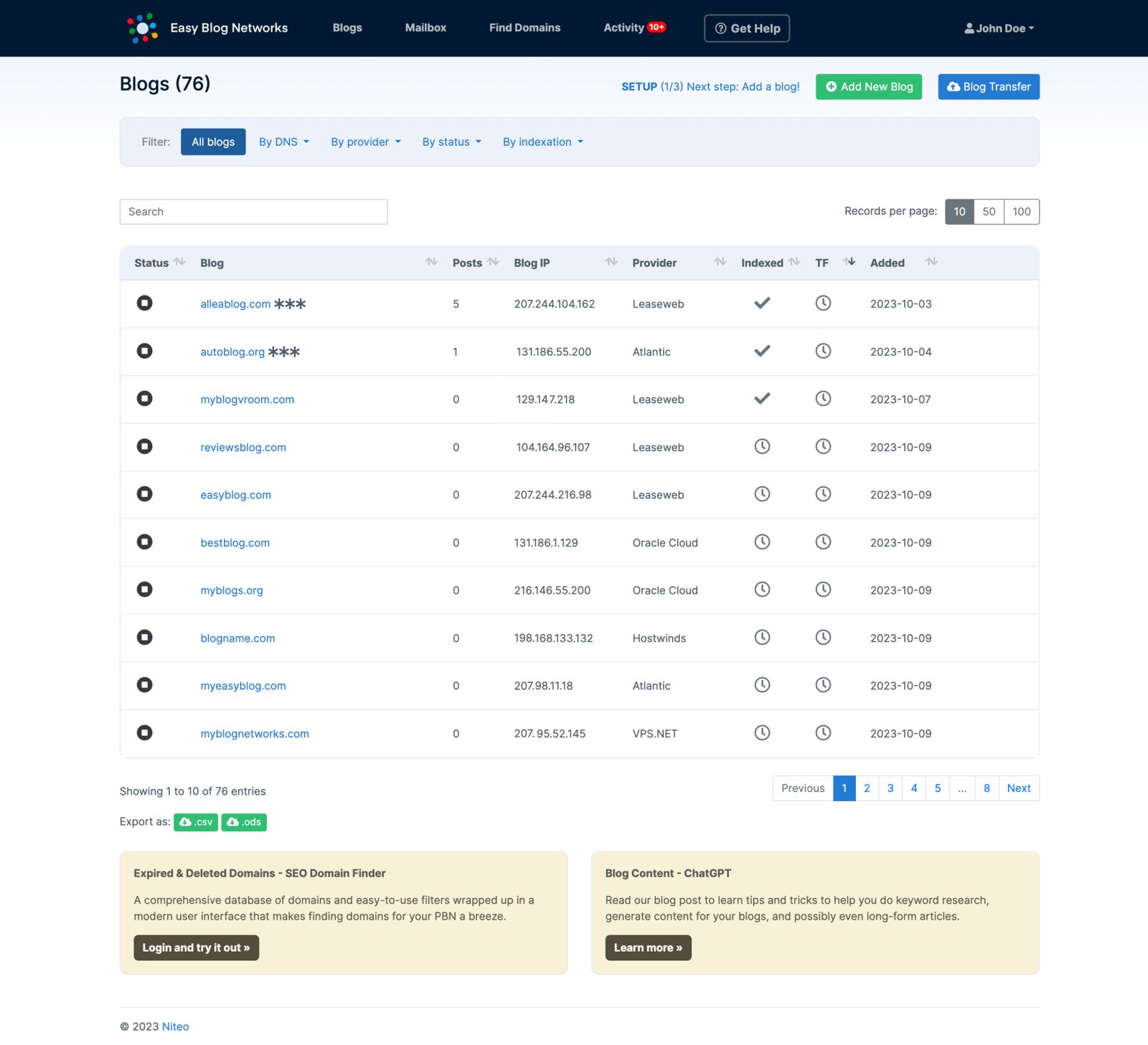
EBN is a managed hosting and site-management layer for people running many independent WordPress sites. The distinction that matters: it is not one hosting account with many sites on it. Each blog is deployed onto a different large cloud host, with that host's own IPs, nameservers and data centers, and every blog is then administered from one dashboard.
EBN names its providers publicly rather than selling anonymous "diverse IPs" — Amazon, GoDaddy, Rackspace and DigitalOcean are the examples listed on its hosting page. The service is operated by Niteo and has been running since 2014. Naming the providers is the substantive difference from classic SEO hosting: you can verify where a blog sits instead of trusting a range.
Source noteArchitecture and provider claims: Safe Hosting on easyblognetworks.com. Verify current specifics on the vendor's pages before purchasing.
Documented capabilities and what each one implies
Every row below is a capability EBN states publicly, paired with our reading of what it changes in practice. The implication column is editorial; the capability column is not.
| Capability | What EBN documents | Operational implication | Source | Verified |
|---|---|---|---|---|
| Provider and IP diversity | Blogs installed on unique IPs across large hosting providers (Amazon, GoDaddy, Rackspace, DigitalOcean), using those providers' nameservers and data centers. Providers are named, not hidden. | Removes the crude one-host, one-IP-block, one-nameserver-pair pattern by default. It does not make a network undetectable — content, links and ownership footprints are still yours to manage. | Safe Hosting | 2026-08-12 |
| 1-click provisioning | Enter domain and blog title; EBN deploys WordPress with a random theme, different plugins, randomized admin username, full name and email, plus a mailbox, on a randomly selected cloud host. | The per-site setup cost drops to about a minute. Randomised install metadata removes the copy-paste registration patterns that manual builds tend to repeat across a batch. | Easy Setup | 2026-08-12 |
| Autopilot maintenance | Automatic WordPress core, theme and plugin updates; daily backups downloadable in one click; automatic nameserver configuration from stored registrar credentials. | Addresses the most common cause of a network quietly degrading: unpatched sites getting compromised. Backups being one click also makes rollbacks realistic rather than theoretical. | Autopilot Maintenance | 2026-08-12 |
| Free migration | EBN moves existing PBN blogs from any host at no charge; an in-app blog transfer form handles batches, with a CSV template for bulk submission. | Usually the deciding practical factor when consolidating an estate. Migration labour, not monthly price, is what keeps most operators stuck on a bad host. | Free Transfer | 2026-08-12 |
| SSL and mailboxes | HTTPS certificates provisioned automatically; a mailbox and webmail login included with every blog. | Both are footprint hygiene as much as convenience: a network where no domain has working email or a consistent certificate story is easier to pattern-match. | Safe Hosting | 2026-08-12 |
| SEO metrics and indexation checks | Indexation status and Majestic metrics (Trust Flow, Citation Flow, external backlinks, referring IPs) surfaced per blog in the dashboard. | Lets you triage a network without third-party crawls for basic questions — is this blog indexed, is it worth keeping. Not a substitute for your own link auditing. | Easy Setup | 2026-08-12 |
| Automated content | Optional AI publishing using your own OpenAI API key, scheduled daily to monthly, with spintax support in prompts. | Useful for filler cadence, risky as a content strategy. Bulk-generated posts are exactly what Google's spam policies target when the output has no value to a reader. | Autopilot Maintenance | 2026-08-12 |
| API access | A public API that lets third-party services create and manage blogs on a user's EBN account, with documentation available on request/approval. | Matters for agencies wiring EBN into internal tooling or client dashboards rather than working blog-by-blog in the UI. | API | 2026-08-12 |
| Trial and plans | A 7-day free trial; plan tiers and per-blog pricing published on the vendor's pricing page. | We deliberately do not reprint prices — tiers change and a stale number is worse than none. Check the live page before budgeting. | Pricing | 2026-08-12 |
Provider and IP diversity
What EBN documentsBlogs installed on unique IPs across large hosting providers (Amazon, GoDaddy, Rackspace, DigitalOcean), using those providers' nameservers and data centers. Providers are named, not hidden.
Operational implicationRemoves the crude one-host, one-IP-block, one-nameserver-pair pattern by default. It does not make a network undetectable — content, links and ownership footprints are still yours to manage.
Safe Hosting · 2026-08-12
1-click provisioning
What EBN documentsEnter domain and blog title; EBN deploys WordPress with a random theme, different plugins, randomized admin username, full name and email, plus a mailbox, on a randomly selected cloud host.
Operational implicationThe per-site setup cost drops to about a minute. Randomised install metadata removes the copy-paste registration patterns that manual builds tend to repeat across a batch.
Easy Setup · 2026-08-12
Autopilot maintenance
What EBN documentsAutomatic WordPress core, theme and plugin updates; daily backups downloadable in one click; automatic nameserver configuration from stored registrar credentials.
Operational implicationAddresses the most common cause of a network quietly degrading: unpatched sites getting compromised. Backups being one click also makes rollbacks realistic rather than theoretical.
Autopilot Maintenance · 2026-08-12
Free migration
What EBN documentsEBN moves existing PBN blogs from any host at no charge; an in-app blog transfer form handles batches, with a CSV template for bulk submission.
Operational implicationUsually the deciding practical factor when consolidating an estate. Migration labour, not monthly price, is what keeps most operators stuck on a bad host.
Free Transfer · 2026-08-12
SSL and mailboxes
What EBN documentsHTTPS certificates provisioned automatically; a mailbox and webmail login included with every blog.
Operational implicationBoth are footprint hygiene as much as convenience: a network where no domain has working email or a consistent certificate story is easier to pattern-match.
Safe Hosting · 2026-08-12
SEO metrics and indexation checks
What EBN documentsIndexation status and Majestic metrics (Trust Flow, Citation Flow, external backlinks, referring IPs) surfaced per blog in the dashboard.
Operational implicationLets you triage a network without third-party crawls for basic questions — is this blog indexed, is it worth keeping. Not a substitute for your own link auditing.
Easy Setup · 2026-08-12
Automated content
What EBN documentsOptional AI publishing using your own OpenAI API key, scheduled daily to monthly, with spintax support in prompts.
Operational implicationUseful for filler cadence, risky as a content strategy. Bulk-generated posts are exactly what Google's spam policies target when the output has no value to a reader.
Autopilot Maintenance · 2026-08-12
API access
What EBN documentsA public API that lets third-party services create and manage blogs on a user's EBN account, with documentation available on request/approval.
Operational implicationMatters for agencies wiring EBN into internal tooling or client dashboards rather than working blog-by-blog in the UI.
API · 2026-08-12
Trial and plans
What EBN documentsA 7-day free trial; plan tiers and per-blog pricing published on the vendor's pricing page.
Operational implicationWe deliberately do not reprint prices — tiers change and a stale number is worse than none. Check the live page before budgeting.
Pricing · 2026-08-12
What changes in day-to-day operations
Adding a blog
Manually, a new site is a chain: buy domain, point nameservers, wait for propagation, create hosting, install WordPress, set up SSL, install a theme, create an admin user, configure email. On EBN it is two fields and a wait. If you add sites in batches of five or ten, that difference is the entire product. Our PBN setup checklist covers the steps that stay yours regardless of host.
Running an existing blog
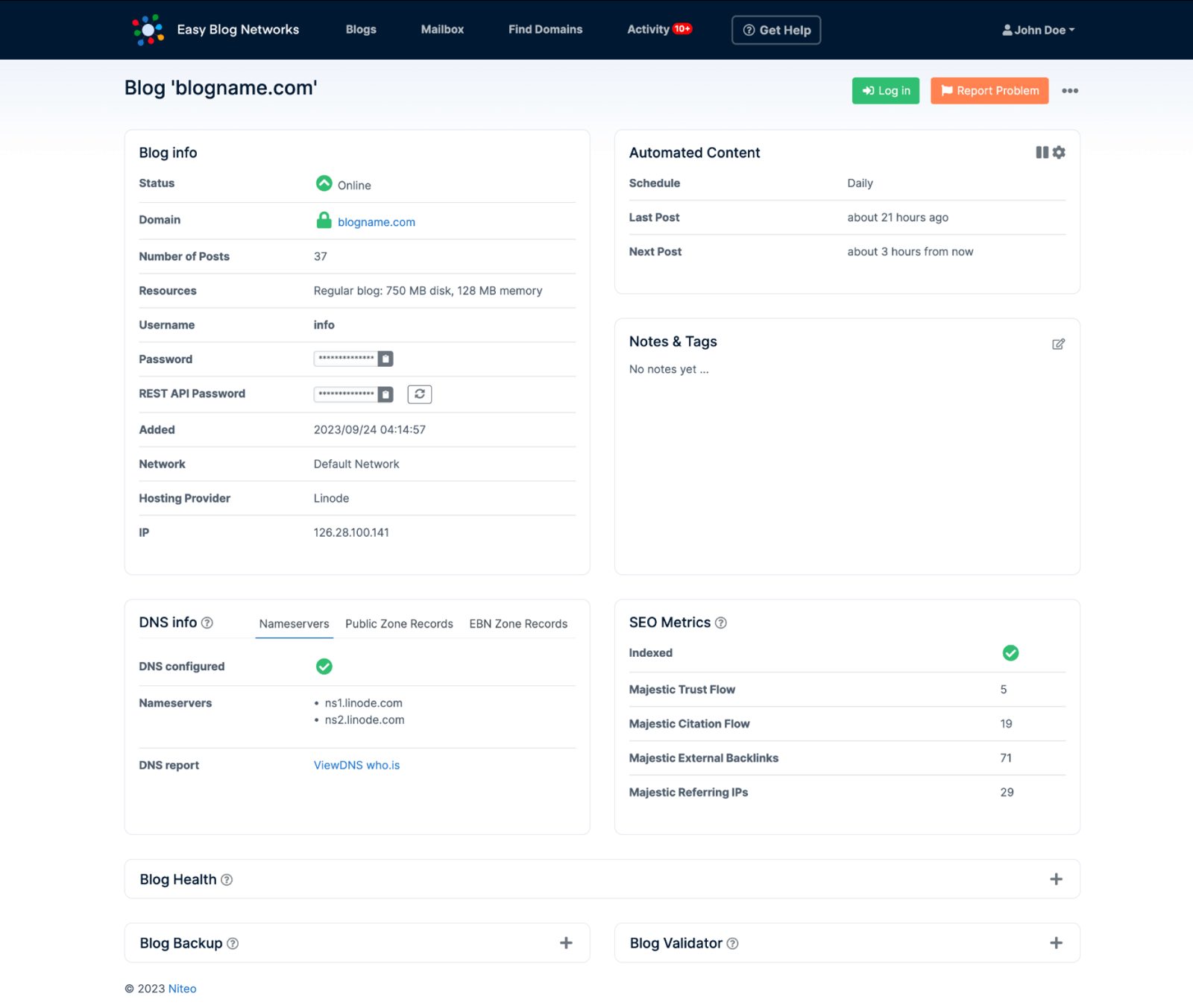
Per-blog, the dashboard exposes the things you actually need when auditing a network: which provider and IP it sits on, whether DNS is configured, whether it is indexed, its Majestic metrics, backup state and a health check — plus one-click login instead of a password spreadsheet.
Moving an existing network in
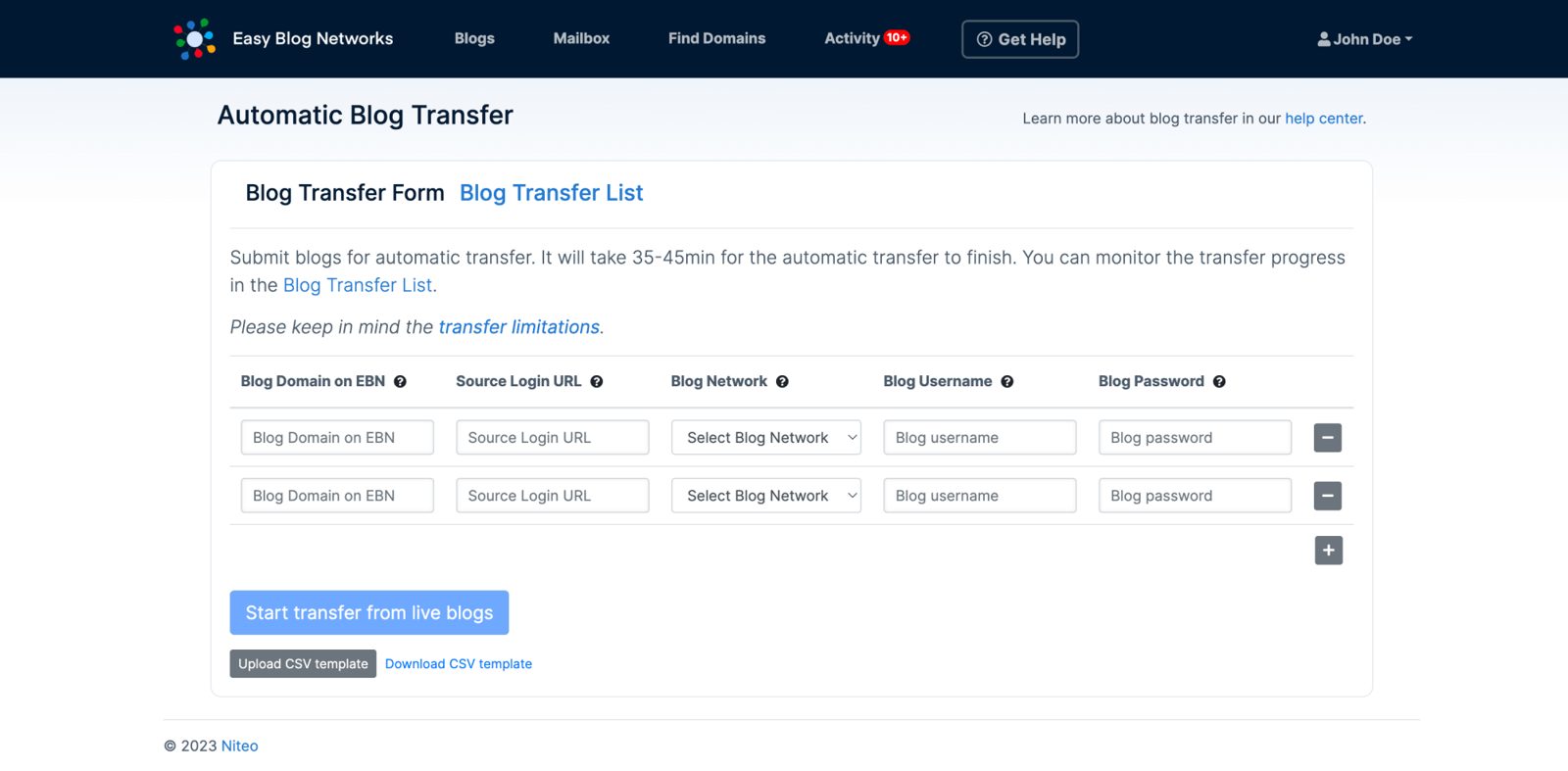
Transfers run through a form in the app: EBN domain, source login URL, current network, username and password per blog, with a CSV template for bulk jobs. EBN states the automated transfer takes roughly 35–45 minutes per run and that the service is free from any host. Practical advice: move a small batch first, confirm indexation holds, then move the rest.
Manual multi-host vs managed: where the cost actually sits
The honest comparison is not price per site — it is total cost including your hours and the probability of neglect. A manual stack wins on control and unit cost; a managed platform wins on consistency and time.
| Dimension | Manual multi-host stack | Easy Blog Networks |
|---|---|---|
| Infrastructure diversity | Achievable, but you must plan providers, IPs, DNS and registrars yourself — and re-plan every batch | Distribution across named large providers handled at platform level |
| Time per new site | 30–60 minutes of chained manual steps | Two fields, then automated deployment |
| Updates and backups | Your responsibility; the first thing that slips when you are busy | Automatic updates and daily backups |
| Server control | Full: root access, any stack, any service | None: managed WordPress environment only |
| Unit cost | Lower per site on paper, before labour | Higher per site, labour included |
| Migration effort | Yours, per blog, every time you change host | Vendor-run free transfer, batchable via CSV |
| Concentration risk | Spread across many vendor relationships you manage | Hosting spread, but one management vendor and one account |
Infrastructure diversity
Manual multi-host stackAchievable, but you must plan providers, IPs, DNS and registrars yourself — and re-plan every batch
Easy Blog NetworksDistribution across named large providers handled at platform level
Time per new site
Manual multi-host stack30–60 minutes of chained manual steps
Easy Blog NetworksTwo fields, then automated deployment
Updates and backups
Manual multi-host stackYour responsibility; the first thing that slips when you are busy
Easy Blog NetworksAutomatic updates and daily backups
Server control
Manual multi-host stackFull: root access, any stack, any service
Easy Blog NetworksNone: managed WordPress environment only
Unit cost
Manual multi-host stackLower per site on paper, before labour
Easy Blog NetworksHigher per site, labour included
Migration effort
Manual multi-host stackYours, per blog, every time you change host
Easy Blog NetworksVendor-run free transfer, batchable via CSV
Concentration risk
Manual multi-host stackSpread across many vendor relationships you manage
Easy Blog NetworksHosting spread, but one management vendor and one account
The break-even is roughly where your own time becomes the scarce resource. Below a handful of sites, manual is defensible. Above ten, managed usually wins on consistency alone. See the full framework in our PBN hosting providers comparison and the cost reasoning in cheap PBN hosting.
Limitations and honest caveats
- WordPress only. Static sites, alternative CMS platforms and custom application stacks have no place here.
- No server-level control. You trade root access, custom stacks and arbitrary services for automation. That is the deal, and it is not negotiable per account.
- Management-layer concentration. Hosting is distributed; administration is one vendor, one account, one billing relationship. Keep your own domain registrar access and backup copies.
- Automation is not anonymity. Randomised installs and mixed providers remove infrastructure patterns. Ownership, content quality, link patterns and anchor text remain entirely your responsibility.
- AI publishing is a loaded gun. The built-in generator is convenient; mass-produced pages with no reader value are precisely what Google's spam policies describe as scaled content abuse.
- No hands-on benchmark from us. BestPBNhost has not published independent speed, uptime, support or indexation testing of EBN. Vendor claims above are marked as claims, with sources.
Should you use it? A decision checklist
Work through these. If most of them are true for you, EBN is a rational choice; if most are false, a manual stack or standard managed WordPress will serve you better.
Six or more ticks: start with the trial and migrate a small batch first. Three or fewer: read the providers comparison before spending anything.
Affiliate link — no additional cost to you. View current plans and the 7-day trial on Easy Blog Networks.
Plans and trial
We do not reprint EBN pricing here, because tiers change and a stale number is worse than none. EBN advertises a 7-day free trial. Check current plans for live figures, and read our cheap PBN hosting analysis for why per-site price alone is the wrong comparison unit.
Affiliate link — no additional cost to you. View current plans and the 7-day trial on Easy Blog Networks.
Frequently asked questions
It removes the crudest infrastructure footprints: blogs are deployed to different large cloud providers with their own IPs and nameservers, installs are randomised, and every domain gets a mailbox and SSL. That is safer than one cheap box hosting twenty sites. It is not safety in the sense of immunity — ownership data, content quality, link patterns and anchor text are still yours to get right.
No. BestPBNhost has not published a hands-on performance benchmark of EBN. This review is research-based: every capability is sourced to the vendor's public documentation and dated. We do not publish speed, uptime, support-response or indexation figures we did not produce ourselves.
Yes. EBN states it transfers blogs from any host at no charge, using an in-app transfer form with a CSV template for bulk jobs, and cites roughly 35-45 minutes per automated transfer run. Move a small batch first and confirm indexation holds before migrating the whole estate.
Pricing is tiered per number of blogs and changes over time, so we point to the vendor's live pricing page instead of reprinting numbers that go stale. EBN advertises a 7-day free trial, which is the cheapest way to evaluate the dashboard against your own workflow.
No. EBN is a managed WordPress environment. Static sites, other CMS platforms and custom application stacks are out of scope, and you do not get root access or the ability to run arbitrary services.
Single-site owners, anyone who needs server-level control, and buyers optimising purely on the lowest possible monthly cost. The platform amortises its value across many sites and a lot of avoided manual work; with one or two sites there is nothing to amortise.
Related guides
PBN Hosting Providers: Compare the Operating Models
A named provider comparison, a selection matrix and a five-question decision flow for choosing a PBN hosting model.
Focuspbn hosting providers, private blog network hosting, pbn hosting service, hosting for pbn, private blog network service
Read guide
Private Blog Network Guide: Architecture, Operations and Risk
The ten operating layers of a private blog network, a layered architecture diagram, and an honest split between hosting-side and non-hosting risk.
Focusprivate blog network guide, pbn guide, private blog network, pbn private blog network
Read guide
Cheap PBN Hosting and the Costs You Do Not See
A browser-local workload calculator, the eight cost categories operators forget, and a four-model total-cost comparison.
Focuscheap pbn hosting
Read guide